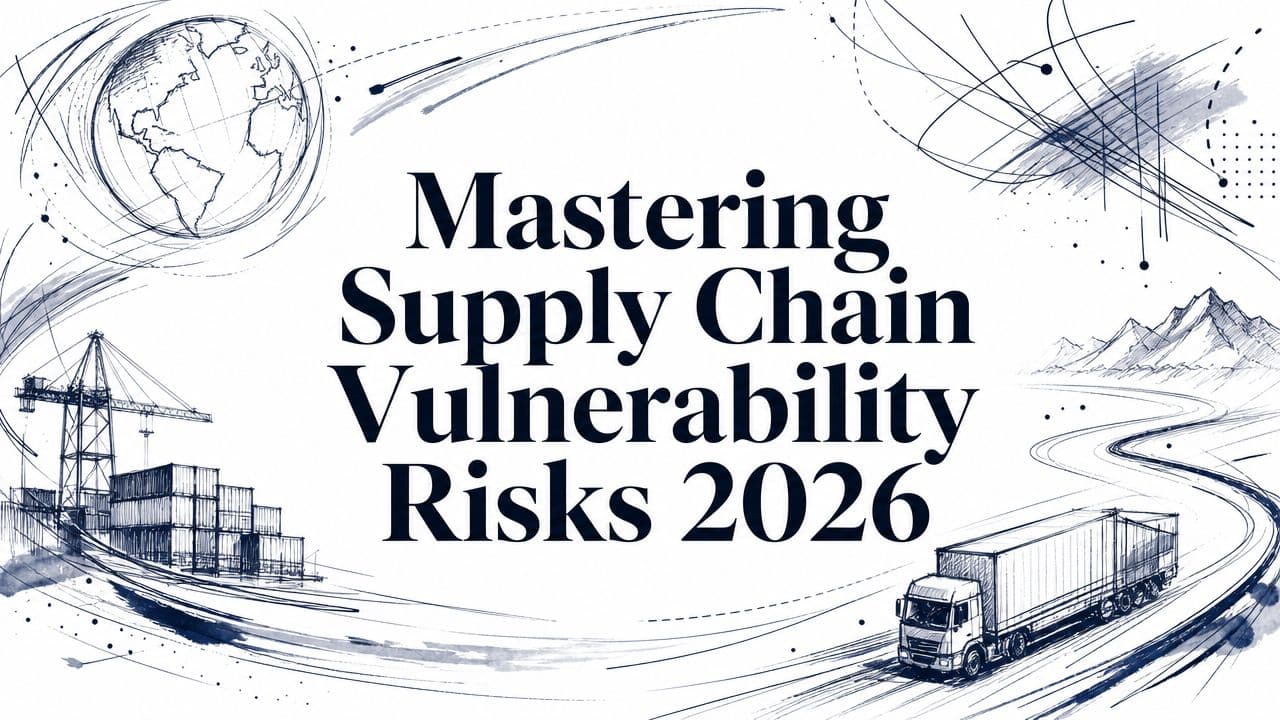
Mastering Supply Chain Vulnerability Risks 2026
A client once asked why their internal app was beaconing to a host nobody recognised. The answer wasn't in their codebase. It was in a trusted package pulled in months earlier, bundled into a build pipeline nobody had reviewed closely.
That's the shape of modern supply chain vulnerability work. You're often testing inherited trust, not just locally written code.
Your Biggest Find Might Not Be in Your Client's Code
A lot of pentesters still treat supply chain vulnerability as a governance problem. Procurement issue. Vendor issue. Something for legal, architecture, or risk teams. In practice, that misses where the interesting findings live.
From an offensive angle, a supply chain vulnerability is any exploitable weakness the client inherits from something external. That could be a package from a public registry, a build runner action, a managed service account with broad access, a remote support tool, a firmware updater, or a cloud integration the client treats as trusted by default. If it runs in the environment, feeds the environment, or can influence deployment, it belongs in scope whether the statement of work says “third party” or not.
The practical mistake is assuming “not developed here” means “not testable here”. It often means the opposite. Third-party components usually arrive with weaker visibility, looser ownership, and stale assumptions. The client may monitor their own app closely while barely understanding what sits underneath it.
What this looks like on a real engagement
A common pattern goes like this:
- You start with an application flaw that looks ordinary. Maybe insecure deserialisation, exposed debug functionality, weak token handling, or suspicious outbound traffic.
- You trace the behaviour upstream into a library, plugin, container base image, CI action, or hosted dependency.
- You realise the client's trust boundary is wrong. The vulnerable component already has privileged placement, broad network reach, or build-time execution.
- The finding becomes inherited compromise risk, not just a local coding issue.
That shift matters because your report has to document exploitability in the client's environment, even when the root cause lives elsewhere.
Practical rule: If a component can execute during build, update, authentication, logging, telemetry, or remote administration, treat it like part of the attack surface, not background plumbing.
Repositories are a good example. Teams often think of them as passive storage, but package and artefact repositories are trust distribution systems. If you need a quick refresher on how those systems shape attack paths, this overview of what repositories are is useful background.
What usually works and what doesn't
What works is testing inherited trust paths directly. Review lock files. Inspect CI references. Follow service principals. Look at update channels. Validate signing assumptions. Monitor what third-party code does at runtime.
What doesn't work is relying on spreadsheet vendor assurance, annual review paperwork, or the phrase “managed by the supplier”. Attackers love that phrase because defenders stop asking technical questions once they hear it.
For a mid-level security team, the useful mindset is simple. Stop asking only, “Is the client's code vulnerable?” Start asking, “What does the client automatically trust, and can I abuse that trust safely enough to prove impact?”
Unpacking the Modern Digital Supply Chain
The cleanest way to explain the modern digital supply chain is to stop thinking about trucks and warehouses for a minute. Think about a professional kitchen.
The head chef controls service, but the meal depends on suppliers, prep processes, specialist equipment, and the final handoff to diners. Security works the same way. A secure application can still be compromised by a poisoned ingredient, a misconfigured oven, or a contaminated serving line.

Software ingredients
Start with the pantry. Teams often look there first, and for good reason.
Third-party libraries, package registries, transitive dependencies, build plugins, container images, and CI actions are the ingredients your application consumes. Some are pinned and verified. Many are not. Some are maintained by mature teams. Others are effectively abandonware with a recognisable name and broad install base.
From a tester's perspective, software supply chain vulnerability usually shows up in a few forms:
- Dependency trust without verification. Teams pull by version tag, latest release, or mutable reference and assume integrity.
- Transitive blindness. Developers know what they installed directly, but not what arrived underneath it.
- Build-time execution. Install scripts, plugins, or actions execute with more privilege than the final app.
- Update channel abuse. Signed or trusted updates are accepted too broadly, or signature validation is weak in practice.
Hardware and operational technology
The kitchen analogy breaks if you only talk about ingredients. Equipment matters too.
Firmware, embedded controllers, network appliances, scanners, edge devices, and unmanaged OT or IoT systems sit below the application layer but still shape risk. They're often excluded from “software” reviews even when they hold credentials, expose management interfaces, or bridge trusted network zones.
UK-relevant cyber guidance increasingly points out that the risk surface is widening beyond logistics into software, OT, and third-party access, with blind spots including MSP channels, cloud services, and unmanaged OT/IoT devices, as discussed in this analysis of third-party risk blind spots.
When a vendor account or connected device becomes the weak link, traditional supplier reviews don't help much. You need to validate what can actually be reached, authenticated to, and abused.
Service layers and invisible trust
Cloud platforms, identity providers, managed service providers, telemetry tools, customer support integrations, and external APIs are the kitchen utilities. Water, gas, refrigeration, sanitation. Nobody notices them until one fails or gets tampered with.
That's why mature teams are spending more time on safeguarding business from third-party risks, especially around service relationships that create standing access rather than one-off transactions.
A simple way to map this during an engagement is to classify the target into three groups:
| Layer | Typical examples | Pentest question |
|---|---|---|
| Software | Packages, libraries, registries, build plugins, CI actions | Can upstream code execute or influence artefacts? |
| Hardware and OT | Firmware, appliances, scanners, IoT, embedded controllers | Does the device create hidden trust paths or weak admin surfaces? |
| Services | Cloud, MSPs, identity providers, APIs, support tools | Which external party can authenticate, deploy, or administer? |
If your assessment only covers the application itself, you're testing the plating. The kitchen is somewhere behind it.
Learning from Real-World Supply Chain Breaches
The useful thing about well-known supply chain incidents isn't the headline. It's the attack path. Once you strip away the brand names, the same mechanics show up again and again. Trusted supplier compromised. Malicious or vulnerable component propagated. Customer environments inherited the problem at scale.
SolarWinds and the update channel problem
SolarWinds remains one of the clearest examples of why pentesters should care about build integrity and update trust.
The attacker path was brutally efficient. Compromise the supplier's build or release process, inject malicious code into a legitimate software update, let customers deploy it through normal operations, then use the resulting foothold for selective follow-on access. From a testing perspective, the lesson isn't “assume nation-state capability”. It's “assume trusted update paths are high-value targets because they bypass a lot of local scrutiny”.
What should a security team take from that?
- Review update trust decisions. Ask what gets auto-approved and why.
- Inspect signer trust and validation controls. Don't assume “signed” means “safe enough”.
- Model post-update blast radius. If this agent goes bad, what can it reach next?
Log4j and transitive exposure
Log4j was different in mechanics but similar in outcome. A core embedded component turned into a broad, inherited exposure problem. Many teams didn't struggle because they lacked a patch. They struggled because they didn't know where the component existed.
That's why supply chain vulnerability assessment can't stop at direct dependencies. The operational problem is discovery. You can't prioritise what you can't enumerate, and you can't report clearly if you only know that “something somewhere uses Java logging”.
A pentester should read incidents like Log4j as a lesson in visibility failure:
- The vulnerable component may sit several layers down
- The application owner may not know it's present
- The exploit path may be simple even when remediation is messy
3CX and trusted software in a trusted environment
The 3CX incident is a good reminder that users don't need to do anything obviously unsafe for a supply chain attack to land. The software is legitimate. The distribution path is familiar. The endpoint tooling may even whitelist it because it belongs there.
For reporting, that's gold. It helps clients understand that the issue isn't “careless users downloaded malware”. The issue is that a trusted operational dependency can become the initial access route.
The strongest supply chain findings are rarely the ones with the most technical novelty. They're the ones that show how normal business processes can be used as the delivery mechanism.
There's also a wider policy point. The UK National Risk Register 2023 formally identifies interruption to fuel and food supply as major civil risks, which shows supply chain weakness is now treated as a national resilience issue rather than just a commercial inconvenience, as noted in this discussion of the UK policy shift on systemic supply chain risks. Security teams should read that as permission to treat supply chain findings as board-level material when impact supports it.
Techniques for Assessing and Detecting Vulnerabilities
Most supply chain vulnerability guidance stops at “maintain visibility”. That's true, but not very useful on a live engagement. You need ways to find what's exploitable, test it safely, and record evidence cleanly.
The first principle is simple. Map trust before you test execution. If you don't know what the environment pulls, installs, signs, updates, or delegates to external systems, you'll miss the routes that matter.
Build the dependency picture first
The UK Government's cyber threat guidance states that software is the primary vector for supply-chain threat movement, with observed compromise methods including open-source components, hijacked code signing, and compromised updates. The same guidance points to dependency inventory, SBOM coverage, and update-signing verification as effective controls, which makes them equally useful for assessment work in a pentest context, as covered in this guidance on cyber threats to supply chains.
Start with artefacts that already exist:
- Lock files and manifests such as package locks, requirements files, module definitions, and build descriptors
- Container build definitions including base images and pull references
- Pipeline configurations that call external actions, plugins, runners, or package feeds
- Installer and updater logic where applications retrieve binaries or packages after deployment
An SBOM helps, but only if it's current and tied to the actual build. If the SBOM is generated from source while production is built from a separate process, trust the runtime artefact over the document.
Check what executes during build and deploy
Build systems routinely have more privilege than the app they produce. That means CI/CD is where many of the best supply chain findings live.
Look for:
- Mutable references such as tags instead of immutable commit pins
- Untrusted script execution during install or build steps
- Broad secrets exposure to jobs that only need narrow access
- Shared runners or weak isolation between projects or trust levels
If you're reviewing pipelines, this checklist for CI/CD pipeline security is a practical baseline for structuring tests and evidence.
A lot of this overlaps with standard code review. The difference is emphasis. You aren't only identifying security flaws in application logic. You're validating whether external code can run with trusted access before the application even exists. For teams refining review processes, this guide on identifying security flaws is a useful companion because it sharpens the habit of tracing dangerous assumptions rather than only looking for obvious sink functions.
Test behaviour, not just metadata
Static analysis tells you what should happen. Runtime testing tells you what happens.
During dynamic assessment, monitor for third-party components that:
- Initiate unexpected outbound connections
- Request credentials or tokens they shouldn't need
- Load modules or child processes outside normal function
- Expand access after installation, update, or first launch
This doesn't require reckless exploitation. You can often prove risk by instrumenting a test environment, replaying normal operations, and capturing the behaviour of dependencies under controlled conditions. The ethical line is straightforward. Don't poison public ecosystems, don't tamper with vendor property, and don't bypass contractual scope to “test the supplier”. Stay focused on the client-controlled environment and show how inherited trust could be abused there.
Ask vendors and clients better technical questions
Questionnaires are still part of the job, but generic ones produce generic answers. Ask questions you can validate technically.
Try prompts like these:
| Weak area | Better question |
|---|---|
| Update integrity | How are releases signed, and how is signature verification enforced in deployment? |
| Pipeline trust | Are build actions pinned immutably or referenced by mutable tag? |
| Secrets handling | Which jobs can access production credentials, and are those secrets short-lived? |
| Third-party admin access | Which supplier accounts have standing remote access into the environment? |
Document exploitability as you go
A good supply chain finding needs more than “component X is vulnerable”. Capture:
- The inherited component or trust path
- Where it exists in the client environment
- What level of execution or access it has
- What proof you obtained safely
- Which local controls failed to detect or restrict it
If you're standardising report output across a team, a platform like Vulnsy can help structure reusable finding language, evidence capture, and client-ready remediation notes without changing the underlying testing method.
Practical Mitigation and Remediation Strategies
Finding the issue is the easy part. The harder part is advising on remediation when the vulnerable component may belong to someone else, update on someone else's schedule, or sit inside a business process nobody wants to disrupt.
The right approach is to reduce trust concentration first, then fix the component where possible. Teams often do this in the opposite order. They chase the patch while leaving the blast radius untouched.

Reduce blast radius before perfect remediation
Operational resilience guidance treats supply chain vulnerability as both a cyber and physical-flow issue, with critical failure modes including single points of failure in suppliers, transport, and warehousing. The recommended response includes mapping dependencies to business functions, monitoring supplier performance in real time, maintaining alternate supplier options, and driving vulnerability scores from concentration risk and recovery-time assumptions, as described in this guidance on assessing supply chain vulnerability.
The pentest translation is practical. Ask what happens if this dependency fails or turns hostile today.
Start here:
- Segment execution paths so third-party tools, agents, or services can't reach everything by default
- Constrain egress so a compromised component can't talk freely outbound
- Narrow privileges for service accounts, runners, plugins, and automation tokens
- Separate build trust from production trust so compromise in one doesn't automatically own the other
Field note: If a supplier-controlled component sits in a flat network with broad outbound access, the real finding is often architecture, not just versioning.
Choose the least bad remediation option
There isn't one universal fix. There are trade-offs.
Patch
Patching is best when a reliable fix exists and regression risk is low. It's weakest when the supplier's timeline is slow or the dependency graph is too tangled to update cleanly.
Compensate
WAF rules, endpoint controls, allowlisting, stricter validation, and runtime isolation can buy time. They're often necessary, but they shouldn't be written up as equivalent to removing the vulnerable component. They reduce exploitability. They don't erase exposure.
Replace
Sometimes the answer is to remove the dependency entirely. That's disruptive, expensive, and occasionally the only sane option when the component is abandoned, structurally unsafe, or impossible to constrain.
A simple remediation decision view helps:
| Option | Good fit | Main drawback |
|---|---|---|
| Patch | Active supplier, low regression risk | Tied to upstream release quality and speed |
| Compensate | Immediate containment needed | Residual risk remains |
| Replace | Untrusted or unmaintained dependency | Highest implementation cost |
Harden adoption, not just response
The strongest long-term fix is to stop unsafe dependencies entering the environment unchecked.
That means:
- Approve components before use, not after incident response
- Mirror or curate approved packages internally where appropriate
- Require immutable references for build actions and deployment artefacts
- Review maintainer trust and release patterns, not just version numbers
- Enforce secrets discipline because compromised pipelines usually lead straight to credential theft
For teams tightening pipeline and application hygiene, good securing secrets for development teams guidance becomes part of supply chain defence, not a separate discipline. If a malicious dependency lands in CI, secrets quality determines whether it becomes a nuisance or a breach.
There's also a broader programme angle. Strong remediation depends on consistent triage, ownership, and tracking across inherited issues, which is why mature teams fold supply chain findings into wider vulnerability management best practices instead of treating them as one-off exceptions.
Reporting Supply Chain Findings with Clarity and Impact
Supply chain findings are easy to describe badly. The weak version says, “Vendor component vulnerable. Update when possible.” That tells the client almost nothing about their actual exposure.
The strong version separates root cause from client impact. The upstream issue may belong to a supplier, but the local risk belongs to the client if the component runs with trust inside their environment.
Write the finding around inherited risk
Structure the report so the reader can answer four questions quickly:
- What external component or relationship is involved
- Where it exists in the client environment
- How an attacker could use that trust path
- What the client can do now, even if they can't fix the vendor
Useful remediation language often starts with containment, visibility, and validation rather than “patch immediately”. If the client can't change the supplier's code, they can still restrict execution, rotate exposed credentials, pin trusted versions, isolate affected systems, and monitor for abuse patterns.

Make business impact concrete without exaggeration
Clear reporting matters because supply chain incidents move fast from technical weakness to continuity problem. During the COVID-19 period, the Office for National Statistics found that 20% of UK businesses with 10 or more employees were affected by global supply-chain disruption in late March 2020, and half of those affected said the disruption was causing them to scale back or stop trading. The same reporting also noted that 8% of all UK businesses were already facing cash-flow problems linked to the disruption, which is a useful reminder that supply chain failures quickly become operational and financial issues, not just technical ones, as summarised in these UK supply chain disruption statistics.
That's the reporting lesson for pentesters. Don't oversell. Don't write apocalypse. Just show the chain clearly: inherited weakness, trusted placement, realistic exploitation path, and business function at risk.
A reusable finding library helps here because many supply chain issues repeat in form even when the products differ. Consistent language makes it easier to explain a third-party root cause without sounding vague or evasive.
Vulnsy helps pentesters document findings like these in a cleaner, more repeatable way. If you need a reporting workflow for inherited risk, evidence capture, reusable finding language, and polished client deliverables, you can try Vulnsy.
Written by
Luke Turvey
Security professional at Vulnsy, focused on helping penetration testers deliver better reports with less effort.