
A Practical Guide to Network Penetration Testing

Think of network penetration testing as a controlled, authorised cyberattack on your own systems. It’s a bit like hiring a specialist team to try and break into your office building overnight to see if your locks, alarms, and security guards are actually doing their job.
The whole point is to find and safely exploit vulnerabilities before a real attacker does. This hands-on approach shows you exactly how a breach could happen, moving beyond theory and into practical, real-world risk.
What Is Network Penetration Testing
At its heart, network penetration testing is an exercise where a security expert—a pentester—methodically attempts to bypass your security controls and gain access to your network infrastructure. This is worlds away from a simple vulnerability scan, which just catalogues potential weaknesses. A pen test is about actively exploiting those weaknesses.
Let's stick with the building analogy. A vulnerability scan is like looking at the building's blueprints and noting that a window on the second floor has a flimsy latch. A penetration test is when someone actually brings a ladder, jimmies that window open, climbs inside, and sees if they can get to the server room.
Ultimately, a pen test aims to answer some tough but essential questions:
Can someone actually get past our firewalls and other defences?
If they do get in, what can they see, steal, or damage?
Do our monitoring and response teams even notice when an attack is happening?
The Core Purpose and Key Players
The main goal here is to get tangible proof of what's exploitable. Instead of a long, theoretical list of potential problems from a scanner, you get a clear picture of what an attacker could actually do. This helps you focus your time and money on fixing the issues that pose the biggest real-world threat.
The need for this kind of proactive security work in the UK is undeniable. The government’s latest Cyber Security Breaches Survey found that 43% of businesses suffered a breach or attack in the last year. Worryingly, phishing was the starting point in 72% of those incidents. A good pen test can uncover the very gaps that let those initial phishing emails turn into a full-blown crisis. You can dig into the details in the official 2025 Cyber Security Breaches Survey technical report.
A penetration test isn't just about finding flaws; it's about understanding the business impact of those flaws. It transforms abstract vulnerabilities into concrete risks that leadership can understand and act upon.
These tests are carried out by a range of experts, from independent ethical hackers and specialised security consultancies to large-scale Managed Security Service Providers (MSSPs). No matter who you work with, the process is a cornerstone of any mature security programme. It provides the crucial, ground-level intelligence you need to stay one step ahead.
The Five Phases of a Successful Pen Test
A professional network penetration test isn't just a frenzy of hacking. Far from it. It’s a highly structured and methodical process, where each step logically follows the last. Think of it less like a sledgehammer attack and more like a carefully planned heist, with each phase designed to systematically uncover vulnerabilities.
This disciplined approach is what makes a pen test so valuable. It ensures the assessment is thorough, the results are repeatable, and the final report gives you clear, actionable steps to improve your defences. By breaking the engagement down into five distinct phases, testers can map your network, pinpoint weaknesses, and show you exactly what a real-world attacker could do—all without causing unnecessary disruption.
This process ensures that the test moves from initial discovery to active testing, and finally, to the most critical stage: reporting.
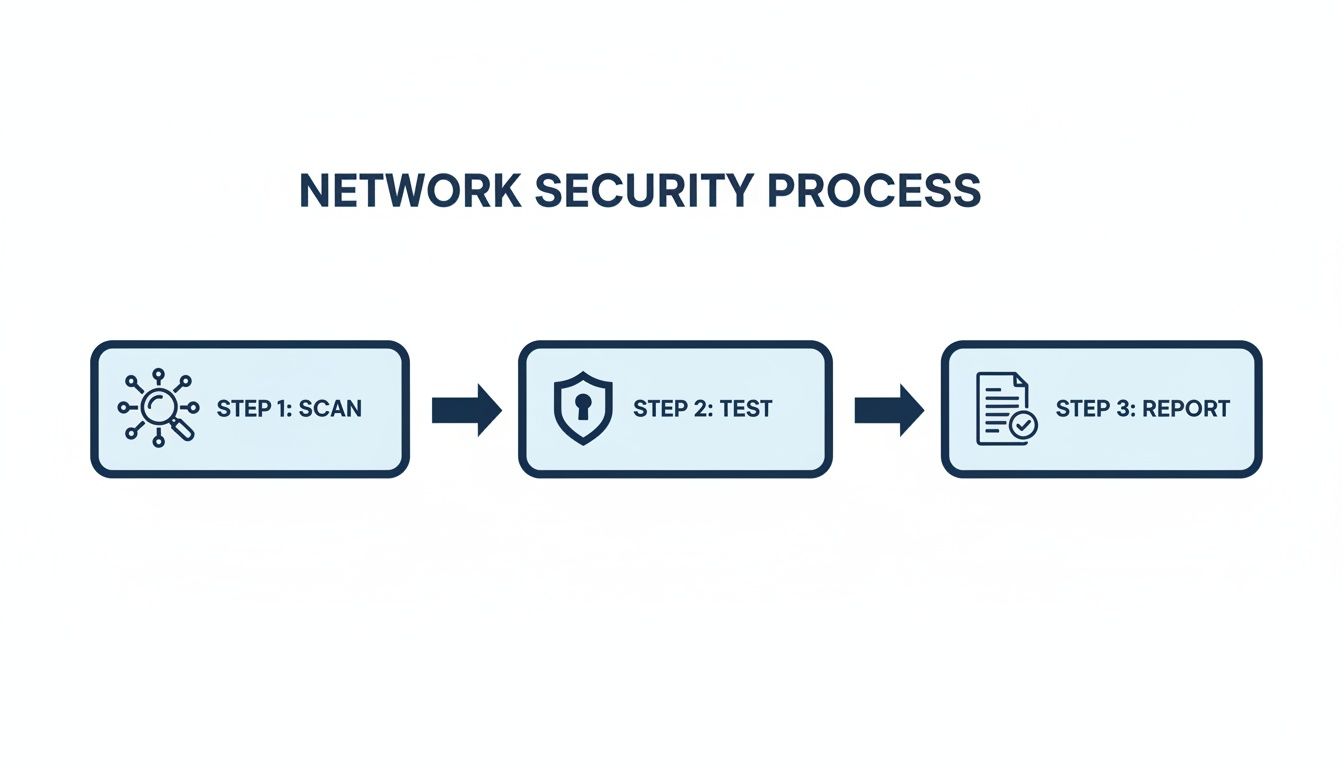
The image above nails a key point: a pen test isn't just about finding flaws. It's a complete cycle that culminates in delivering vital intelligence back to your organisation.
Phase 1: Planning and Reconnaissance
Every successful engagement starts with a solid plan. This first phase is all about preparation and gathering intelligence. Just as a physical security team would study blueprints before entering a building, a pentester begins by defining the scope and rules of engagement with you, the client. This is a crucial step to ensure the test is both legal and perfectly aligned with your business objectives.
Once the boundaries are set, the reconnaissance—or "recon"—begins. This is the digital equivalent of casing the joint. Pentesters use a mix of passive and active techniques to learn as much as they can about your network.
Passive Reconnaissance: This involves gathering publicly available information without directly touching your systems. Think of it as intelligence gathering from a distance. Testers might look at employee details on social media, analyse DNS records, or even scan job postings for clues about the technology you use.
Active Reconnaissance: Here, the tester starts to gently probe your network's perimeter to see what responds. It’s done carefully to avoid setting off alarms and can reveal things like IP address ranges, active hosts, and open ports.
This initial intelligence forms the bedrock of the entire test, guiding every action that follows.
Phase 2: Scanning and Enumeration
With a preliminary map of your digital landscape in hand, it's time for a much closer look. The scanning phase uses specialised tools to actively probe the systems identified during recon for potential weaknesses. It’s like moving from a satellite view to walking the perimeter and checking every door and window for an unlocked entry point.
During this stage, testers are looking to identify:
Open ports and the specific services running on them.
The operating systems and software versions you're using.
Any known vulnerabilities associated with that software.
Enumeration takes this a step further. The goal here is to pull out more granular details like usernames, network shares, and system configurations. Essentially, the tester is building a detailed inventory of potential attack vectors, creating a priority target list for the next phase. You can explore some of the tools used for this among the free security tools available to practitioners.
Phase 3: Gaining Access
This is where theory becomes reality. Also known as the exploitation phase, this is where the pentester actively tries to exploit the vulnerabilities found during scanning to gain unauthorised access. It's the moment of truth that confirms whether a potential weakness is a genuine, exploitable risk to your organisation.
An exploit is a piece of code or a sequence of commands that takes advantage of a bug or vulnerability. A successful exploitation proves that the vulnerability is not just a theoretical problem but a tangible threat.
A win in this phase could mean taking control of a web server, accessing a sensitive database, or grabbing credentials that open the door to your internal network. Each successful breach serves as a powerful proof of concept, demonstrating a clear path an attacker could follow.
Phase 4: Maintaining Access
For a real attacker, getting in is just the first step. The fourth phase, maintaining access, simulates what a determined adversary would do next. The objective is to see how deep they can burrow into the network and whether they can establish a persistent foothold.
This involves techniques like installing backdoors, escalating privileges from a standard user account to an administrator, and moving laterally across the network to compromise other systems. This phase is absolutely critical for understanding the full business impact of a breach. It answers the scary but necessary question: "If one machine is compromised, what else is at risk?"
Phase 5: Analysis and Reporting
The final, and arguably most important, phase is where all the findings are documented in a clear, comprehensive report. A great report does more than just list vulnerabilities; it translates technical findings into business risk.
It should include an executive summary for leadership, deep technical breakdowns for your IT teams, and prioritised, step-by-step guidance for fixing the issues. This report is the ultimate deliverable of the pen test. Without clear analysis and reporting, the test is just a technical exercise. With it, it becomes a powerful roadmap for strengthening your entire security posture.
To give you a clearer picture, here's a quick summary of how these phases fit together.
Network Penetration Testing Phases at a Glance
Phase | Primary Objective | Common Activities |
|---|---|---|
1. Planning & Recon | Define scope and gather initial intelligence on the target. | Client meetings, defining rules of engagement, open-source intelligence (OSINT), DNS queries. |
2. Scanning & Enumeration | Identify live systems, open ports, services, and potential vulnerabilities. | Port scanning (Nmap), vulnerability scanning (Nessus), user and service enumeration. |
3. Gaining Access | Exploit identified vulnerabilities to gain initial access to a system. | Using Metasploit, password cracking, exploiting web application flaws (SQLi, XSS). |
4. Maintaining Access | Establish persistence and move laterally to access other systems. | Installing backdoors, privilege escalation, pivoting to internal network segments. |
5. Analysis & Reporting | Document findings, assess business impact, and provide remediation guidance. | Writing the executive summary, detailing technical findings, recommending security controls. |
This structured flow ensures that every angle is covered, providing you with a complete and actionable assessment of your network's security.
Uncovering and Fixing Common Network Vulnerabilities

A network penetration test goes far beyond ticking boxes on a security checklist. It’s about finding the actual, exploitable gaps in your defences that a real-world attacker would use against you. And while every network has its own unique quirks, we see the same critical vulnerabilities crop up time and time again, regardless of the industry. These are the usual suspects, the low-hanging fruit that attackers love to find.
Tackling these flaws isn't just a technical clean-up job; it's a core business responsibility. A single unpatched server or one lazy password can be the one loose thread that, when pulled, unravels your entire security posture. Getting to know these common culprits is the first, most crucial step toward building a genuinely resilient defence.
The threat landscape is always shifting. In fact, serious cyber attacks have reportedly doubled in the UK over the past year, according to the NCSC Annual Review. But the old classics, like injection flaws and broken access controls, remain firm favourites for attackers. This is exactly why pen tests are so essential—they help you find and fix these pervasive problems before they become front-page news.
Unpatched Software and Systems
One of the most common and dangerous discoveries we make is outdated software. Think of an unpatched server like a house with a faulty lock that the manufacturer has already issued a recall for. Everyone knows about the flaw, including the burglars. Attackers are constantly scanning the internet for systems running software with known Common Vulnerabilities and Exposures (CVEs), making them incredibly easy targets.
A classic real-world example is a public-facing web server running an old content management system. An attacker can use a simple, automated script to find it, exploit the known bug in minutes, and gain a foothold. From there, it's a short hop to launching a devastating ransomware attack across the internal network.
Remediation Guidance:
Implement a Robust Patch Management Policy: Don't leave it to chance. Set a strict schedule for applying security patches, and always start with your most critical, internet-facing assets.
Use Automated Scanning Tools: You should be scanning your network regularly to spot outdated software and missing patches. Find them before a pentester—or an attacker—does.
Establish a Decommissioning Process: Old, unsupported software and hardware are ticking time bombs. Make sure you have a formal process to retire and remove them from the network to eliminate these forgotten risks.
Weak and Default Credentials
It’s almost hard to believe, but the use of weak, predictable, or default credentials is still rampant. Passwords like "Password123" or default logins like "admin/admin" on routers and switches are the digital equivalent of leaving your front door wide open with a "welcome" mat outside.
An attacker might use a technique called password spraying, where they try just a handful of common passwords against hundreds of different user accounts. It's a slow and steady approach that often flies under the radar of account lockout policies, and it’s a surprisingly effective way to gain that initial access.
Default credentials aren't just a vulnerability; they are a guaranteed entry point. Changing them on all devices during setup should be a non-negotiable security step for any organisation.
Remediation Guidance:
Enforce Strong Password Policies: It's a basic for a reason. Mandate long, complex passwords or, even better, passphrases for all user accounts and systems.
Deploy Multi-Factor Authentication (MFA): This is one of the single most effective security controls you can implement. Require a second form of verification for all critical systems, especially for remote access and admin accounts.
Audit for Default Credentials: Make it a regular habit to check all your network devices, from printers to firewalls, to ensure no default usernames or passwords are still in use.
Misconfigured Firewalls and Access Controls
Firewalls and access control lists (ACLs) are meant to be the gatekeepers of your network. But if they're not configured correctly, they're completely useless. A depressingly common finding is an overly permissive firewall rule, like allowing "any/any" traffic. This often happens after a temporary change is made for troubleshooting and then simply forgotten, effectively leaving the gate wide open.
Similarly, poor network segmentation can turn a small problem into a catastrophe. If an attacker compromises a low-value system, like a PC in the marketing department, they shouldn't be able to just wander over to the finance department's servers. Without those internal boundaries, a minor breach quickly becomes a major disaster. Sorting these issues is a fundamental part of the strategies we cover in our guide to vulnerability management best practices.
Remediation Guidance:
Adopt a "Least Privilege" Principle: Your firewall rules should deny everything by default. Only permit the specific traffic that is absolutely essential for business to function.
Implement Network Segmentation: Carve your network up into smaller, isolated zones. This helps contain any potential breach and stops attackers from moving laterally across your infrastructure.
Conduct Regular Rule Audits: Get into the habit of reviewing all your firewall and ACL configurations periodically. Clean out old or overly permissive rules and make sure they still align with your current business needs.
How to Scope and Manage a Testing Engagement
Technical wizardry alone won't deliver a successful network penetration test. The most impactful engagements are always built on a solid foundation of clear business objectives, meticulous planning, and robust legal groundwork. This is where you turn broad security goals into a well-defined project, making sure the entire test is purposeful, legal, and genuinely valuable.
Before a single packet is ever sent, the client and the testing team have to agree on the scope. Think of this as the blueprint for the entire engagement. It lays out exactly what’s being tested, what the end goals are, and what the rules of engagement will be. Getting this wrong can lead to wasted effort, overlooked vulnerabilities, or even accidentally knocking over production systems.
Defining Your Testing Approach
A crucial part of scoping is deciding on the right testing methodology. The amount of information you give the pentester directly shapes the kind of test they’ll run, with each approach simulating a different type of attacker. There are three main models to consider.
Black-Box Testing: Here, the tester starts with almost zero information about the target network. They step into the shoes of an external attacker, relying purely on public information and their own reconnaissance skills to map and attack the target. This is a brilliant way to simulate an opportunistic attack from the outside.
White-Box Testing: This is the polar opposite. The tester gets the keys to the kingdom—full details of the network, including diagrams, source code, and even administrator-level credentials. This "full knowledge" approach allows for a much deeper and more efficient audit, perfect for finding complex flaws an outside attacker might never spot.
Grey-Box Testing: A popular middle ground, this approach gives the tester some limited information, like the login details for a standard user. It’s ideal for simulating an insider threat or an attacker who has already managed to get a foothold on the network, offering a balanced perspective on both internal and external risks.
Choosing the right model really comes down to what you’re trying to achieve. Worried about attackers from the internet? A black-box test is your best bet. Concerned about what a disgruntled employee could do? Grey-box is a much better fit.
A well-defined scope is the bedrock of any professional engagement. It aligns expectations, provides legal protection, and ensures the test delivers actionable insights rather than just noise. It's the difference between a targeted security assessment and a chaotic, unfocused exercise.
Establishing Legal and Ethical Guardrails
A signed contract isn't just a nice-to-have; it's an absolute necessity. A penetration test involves deliberately trying to break into computer systems. Without explicit, written permission, that activity is illegal. This contract, often called a Statement of Work (SOW), must clearly define the rules of engagement.
This document is effectively your "get out of jail free" card and must spell out:
Authorised Targets: A precise list of the IP addresses, domains, and applications that are in scope.
Testing Window: The specific dates and times when testing is permitted, so you don't disrupt critical business operations.
Forbidden Actions: Any techniques that are strictly off-limits, like Denial of Service (DoS) attacks that could bring down vital systems.
Contact Information: An emergency contact on the client's side who can be reached immediately if something goes wrong.
This legal framework protects both the client and the consultant, fostering a transparent and professional relationship. It also helps justify the investment. The cost of a network penetration testing engagement in the UK typically falls between £2,000 and £15,000, which can vary widely based on the size and complexity of the environment. By scoping the work clearly and tying it to specific risk-reduction goals, consultants can confidently show the return on that investment. You can find more details on UK pen testing costs and benchmarks.
Transforming Your Pentesting Reports

The final report is the whole point of a network penetration test. It’s where all the long hours of scanning, prodding, and exploiting turn into something tangible for the client. But for too many security professionals, this crucial deliverable is the biggest bottleneck in the entire engagement.
A good report isn't just a list of vulnerabilities. It's a story. It has to clearly translate technical findings into real-world business risks, bridging the gap between your security team and the people holding the purse strings. It needs to speak two languages at once: one for the boardroom and another for the server room.
This is exactly why manual report writing is such a grind. You're constantly switching hats, juggling screenshots, rephrasing technical jargon for a non-technical audience, and wrestling with document formatting. It’s a huge time-sink that pulls you away from the actual testing work.
The Anatomy of a High-Impact Report
What separates a mediocre report from a great one? Clarity and actionability. The document has to be meticulously structured, guiding the reader logically from the big-picture risk down to the nitty-gritty technical details.
Every professional report worth its salt is built around these core components:
An Executive Summary: This is your elevator pitch for the C-suite. It must be short, sharp, and completely free of jargon, focusing on the overall security posture and what the findings could mean for the business.
Detailed Technical Findings: This is the heart of the report, written for the IT and security teams who will be doing the fixing. Each vulnerability needs a clear description, a severity rating, and solid proof-of-concept evidence like screenshots or code snippets.
Actionable Remediation Steps: It's not enough to just point out the problems. You have to provide clear, step-by-step instructions on how to fix every single issue, prioritised by how much risk it poses.
Getting this balance right by hand is a tough ask, especially if you’re a solo tester or part of a small team juggling multiple projects. Every minute you spend fighting with a word processor is a minute you’re not spending finding the next critical vulnerability.
The real goal of a penetration test report isn't to show off how clever you are; it's to drive meaningful change. If the report is confusing or doesn't communicate risk well, the whole engagement has missed the mark.
Moving Beyond Manual Reporting
The old-school approach of piecing together reports in a word processor is slow, frustrating, and prone to errors. It’s an endless cycle of copy-pasting, reformatting, and proofreading that slows down delivery and can introduce inconsistencies that damage your credibility.
This is precisely the problem that modern reporting platforms are designed to solve. By automating the most tedious parts of documentation, these tools free you up to focus on what you're best at: testing. Instead of starting from a blank page every single time, you can use structured templates and pre-written content to generate professional reports in a fraction of the time. If you're looking to level up your process, exploring modern approaches to penetration testing reporting is a logical next step.
Key Features of Modern Reporting Platforms
These specialised tools bring a level of efficiency that you just can't match with manual methods. They are built with the typical network penetration testing workflow in mind, with features designed to eliminate common headaches.
Some of the most valuable features include:
Reusable Finding Libraries: Why write out the description for SQL injection for the hundredth time? With a findings library, you can pull a pre-written, quality-checked explanation and simply customise the specifics. This saves an incredible amount of time and keeps your reporting consistent.
Automated Templates: You can create professional, branded templates once and reuse them for every project. The platform handles all the formatting, ensuring every report looks polished and consistent without you having to lift a finger.
Secure Client Portals: Emailing sensitive reports is both insecure and clumsy. A dedicated client portal gives your clients a secure, central hub to access their reports, track the progress of fixes, and communicate directly with your team.
By bringing tools like this into their workflow, solo consultants and security teams can deliver better results, faster. This shift allows them to take on more projects, keep clients happier, and ultimately grow their business by focusing on high-value security work instead of getting bogged down in administrative tasks.
Your Network Pen Testing Questions, Answered
Even when you understand the theory, the practical side of commissioning a network penetration test can bring up a lot of questions. Getting these answers sorted out early on is the key to aligning expectations between the security team and the business, ensuring the whole exercise is as valuable as possible.
Let’s clear up some of the most common queries we hear from clients. Think of this as the practical advice you need to navigate the logistics and strategy behind a professional security assessment. Getting these details right from the start makes for a much smoother and more impactful engagement.
How Often Should We Be Doing This?
As a rule of thumb, an annual penetration test is the bare minimum for most organisations. But honestly, that’s just a baseline. The right frequency really comes down to your specific situation—how quickly your environment changes and the kind of threats you’re up against.
You should definitely schedule a test more often if you’re making significant changes to your infrastructure. Think deploying new critical applications, migrating key services to the cloud, or overhauling a major part of your network architecture.
It's better to see pen testing not as a one-off check-up, but as a continuous cycle of security validation that keeps pace with your business. For instance, companies in highly regulated sectors like finance or healthcare often have compliance mandates that require more frequent testing, sometimes even quarterly.
What’s the Difference Between a Penetration Test and a Vulnerability Scan?
This is probably one of the most critical distinctions to grasp. A vulnerability scan is an automated process. Imagine it as looking over a building's blueprints to spot potential design flaws. It’s great at identifying a list of known vulnerabilities based on things like software versions and configurations, but it stops there. It doesn't actually check if those flaws can be exploited.
A network penetration test, on the other hand, is a manual, hands-on assault. An ethical hacker takes that list of potential weaknesses and actively tries to break through them, simulating what a real attacker would do.
Vulnerability Scan: Gives you a list of potential problems. It answers the question, "What weaknesses might we have?"
Penetration Test: Confirms which of those problems are actual risks. It answers, "What could an attacker really do with these weaknesses?"
In short, a scan gives you a theoretical inventory of issues. A pen test delivers practical proof of what's truly exploitable and shows you the potential business impact.
How Should We Prepare for a Pen Test?
Good preparation is what separates a truly valuable engagement from a frustrating one. Rushing into a test without a clear plan can lead to confusion, delays, and a less thorough assessment. A well-prepared client makes for a much more effective test.
First, define your goals. What are your biggest security worries? What are your most critical digital assets? Knowing what you want to protect helps the tester focus their efforts where it counts. From there, work with the testing team to establish a crystal-clear scope, outlining which systems are in play and—just as important—which are strictly off-limits to avoid any disruption to your operations.
You'll also need to sort out a few key logistics:
Designate a Point of Contact: Pick one person on your team to be the main liaison. They should be available to communicate with the testers and handle any issues that pop up.
Sign a Formal Agreement: Make sure a proper contract or Statement of Work (SOW) is signed by everyone. This is the legal document that protects both sides and lays out the official rules of engagement.
Provide Necessary Information: For white-box or grey-box tests, be ready to hand over things like network diagrams or user credentials. This information allows for a much deeper and more efficient analysis of your systems.
Laying this groundwork ensures the test runs smoothly and gives you the actionable insights you need.
Ready to transform your reporting process and deliver professional, high-impact results in a fraction of the time? Discover how Vulnsy automates the tedious work of report writing so you can focus on what you do best. Streamline your workflow, impress your clients, and scale your security practice by visiting https://vulnsy.com to start your free trial today.
Written by
Luke Turvey
Security professional at Vulnsy, focused on helping penetration testers deliver better reports with less effort.