A Complete Guide to Social Engineering Pentest
When we talk about a social engineering pentest, we're not trying to break through firewalls or crack complex passwords. Instead, we're testing the one thing that technical safeguards can't always protect: your people. It's a simulated attack where we, as ethical hackers, use the same deception tactics as real criminals—from convincing phishing emails to impersonation phone calls—to see how your team reacts.
The core idea is to find out if someone could be tricked into handing over the keys to the kingdom.
Understanding Your Human Firewall
 FIREWALL' sign.">
Think of it this way: a standard pentest checks all the locks on your building. A social engineering pentest checks if an attacker can just talk someone into letting them in through the front door. It’s built on a simple, uncomfortable truth of our industry: the strongest security systems mean nothing if an employee can be manipulated into bypassing them.
This isn't about catching people out or pointing fingers. It’s a powerful diagnostic tool. The real aim is to get a realistic picture of how well your security awareness training and internal procedures hold up under pressure. We want to find the cracks before a real adversary does.
Why It Is an Essential Security Practice
Time and again, attackers have proven that exploiting human trust is the path of least resistance. It's often far easier than navigating sophisticated digital defences. A social engineering pentest gives you a tangible measure of this human risk—something that automated tools and traditional network tests just can't provide.
Running these simulations in a controlled way delivers invaluable insights. This proactive approach helps you:
Identify Training Gaps: You can see exactly which teams or individuals might need more focused security awareness coaching.
Validate Security Controls: Are your email filters and security policies actually effective against a clever, targeted attack? This is how you find out.
Improve Incident Response: It’s a live drill. You get to see how quickly your team spots, reports, and handles a potential breach.
The need for this kind of testing is more urgent than ever. The 2023 KnowBe4 Phishing Benchmarking Report found that the Phish-Prone Percentage (PPP) for UK and Irish organisations shot up to 35.2%. For big companies, that number was closer to 40%. This shows just how vulnerable employees are, especially with hybrid work blurring the lines of security vigilance. You can dig deeper into these findings about phishing susceptibility in the UK and Ireland on GBI Impact.
A social engineering pentest moves beyond theory. It provides concrete, empirical data on how your team behaves under pressure, turning abstract risks into measurable outcomes.
Ultimately, this is about fostering a stronger, security-first culture. It's how you turn your biggest potential vulnerability—your staff—into your most vigilant and effective line of defence: a true human firewall.
Walking the Tightrope: Legal and Ethical Lines of Engagement
A professional social engineering pentest has to walk a fine line. On one side, you have the need for a realistic simulation; on the other, an absolute ethical responsibility. We're not just poking at firewalls here. These tests target human psychology, which means we must operate within a strict, unwavering framework of rules.
The golden rule is simple but non-negotiable: do no harm. If the test causes real operational disruption or leaves employees genuinely distressed, we've failed. The whole exercise is pointless.
This framework isn't just about being a good professional—it's about legality and maintaining client trust. Before a single phishing email flies or one phone call is made, every engagement must start with explicit, written authorisation. This is the bedrock of any ethical test.
Setting Clear Rules of Engagement
The foundation of a safe and effective social engineering pentest is a meticulously defined scope. I'm not talking about a vague handshake agreement, but a detailed contract that draws firm boundaries. It needs to clearly outline who is in scope, what tactics are fair game, and exactly what data can be accessed to prove a vulnerability has been found.
This document is critical for two reasons:
For the Client: It gives them total transparency and control. They know the test will align with their security goals without crossing any lines they're uncomfortable with.
For the Tester: This is your professional shield. That written permission, often called a 'get out of jail free' letter, is the only thing separating your work from illegal activity.
Let's be blunt: without this formal agreement, a pentester is legally no different from a criminal. It's the single most important document you'll handle.
Defining Ethical Boundaries and Red Lines
While the scope tells you what you can do, a strong ethical code dictates what you shouldn't. There are certain lines a responsible social engineering pentest must never cross, no matter how effective a tactic might seem. Remember, the goal is to uncover weaknesses, not to traumatise staff.
For instance, any pretext involving a family emergency, a personal health crisis, or the threat of someone losing their job is completely out of bounds. These tactics are designed to manipulate raw fear and panic, causing real distress that has no place in a professional assessment. Likewise, digging into genuinely private employee information or sensitive customer data—beyond the absolute minimum needed to prove the objective—is an unacceptable breach of trust.
The objective is to simulate a threat, not to become one. An ethical social engineering pentest strengthens an organisation's security posture without damaging its most valuable asset: its people.
The entire test must be a constructive exercise. We're here to demonstrate a potential weakness, not to exploit it fully. Think of it like taking a screenshot of a sensitive file directory to prove access, rather than exfiltrating the files themselves. This approach proves the vulnerability without causing an actual data breach. By sticking to these ethical red lines, the engagement stays safe, responsible, and becomes a truly valuable tool for building a more resilient, security-aware culture.
A Step-by-Step Guide to a Professional Social Engineering Pentest
A proper social engineering pentest isn't just about sending a few dodgy emails. Think of it less like a chaotic attack and more like a carefully planned surgical procedure. Every phase is meticulously designed and executed to hit specific objectives without causing any collateral damage.
This framework breaks the whole thing down into a clear, actionable sequence. It takes you from the silent, early stages of intelligence gathering all the way through to the controlled execution of the simulated attack and, finally, a secure clean-up.
This visual flow highlights the core ethical pillars that underpin any legitimate engagement, guiding the process from the initial agreement to the final report.
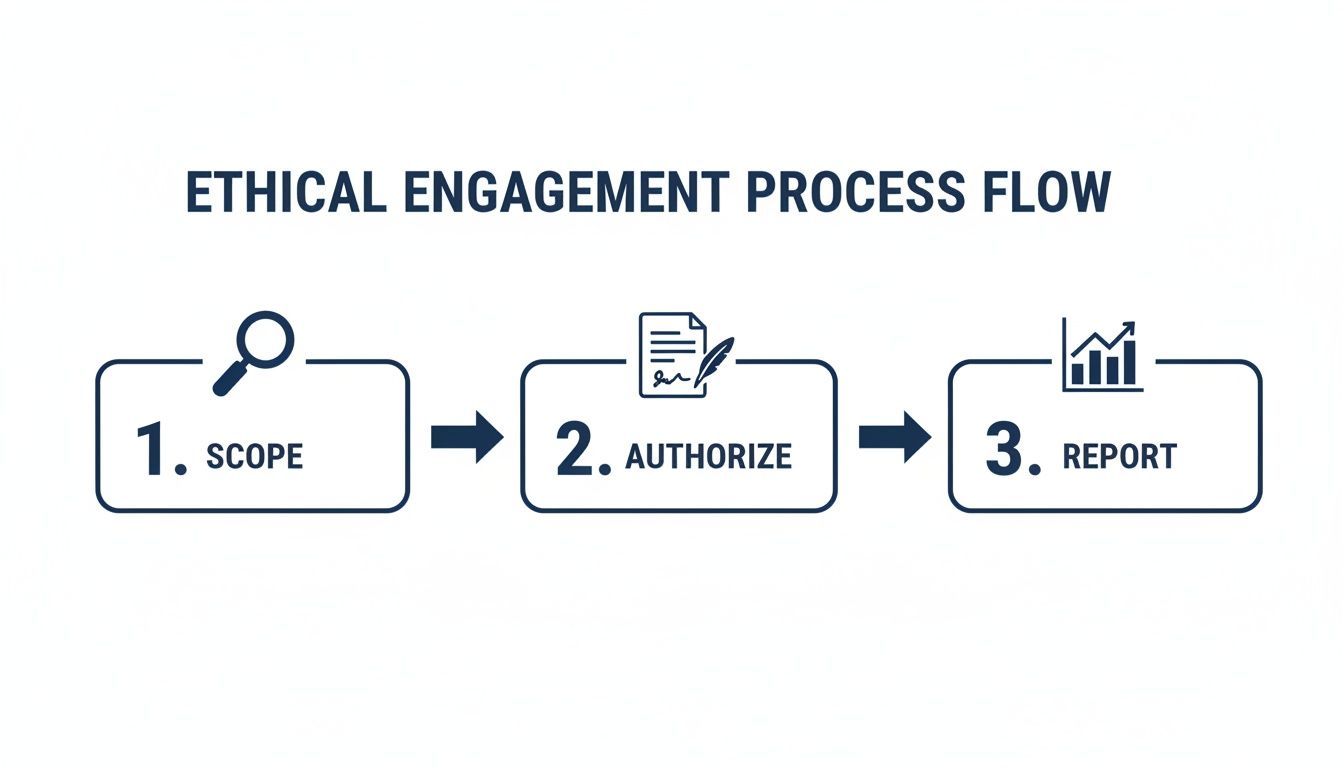
Following this process ensures every action we take is purposeful, fully authorised, and directly aimed at making the organisation more secure.
Phase 1: Reconnaissance and Intelligence Gathering
Every great social engineering campaign starts not with an attack, but with listening. This reconnaissance phase is all about gathering as much publicly available information as we can on the target organisation and its people. This is where Open-Source Intelligence (OSINT) becomes our most powerful tool.
The aim is to build such a detailed picture that our fabricated stories, or pretexts, become incredibly believable. We'll be scouring all sorts of places for intel, including:
Company Websites: We’re looking for organisational charts, department names, and key staff mentioned in press releases or on the "About Us" page.
Social Media Profiles: We’ll check out employee posts on platforms like LinkedIn to understand their roles, who they work with, and even personal interests that could be woven into a pretext.
Public Records and News: Corporate reports or news articles can be a goldmine, revealing new projects, key vendors, or recent internal changes.
This intelligence is the fuel for a convincing narrative. For example, finding the name of the Head of IT on LinkedIn allows us to craft a vishing call that’s far more credible than a vague impersonation of "someone from the IT department."
Phase 2: Choosing an Attack Vector and Designing the Scenario
With a pile of intelligence at our fingertips, the next move is to weaponise it. This means picking the right attack vector and designing a realistic scenario. It’s not about finding the most technically complex method, but the one most likely to exploit the human behaviours we observed during our recon.
The vector we choose depends entirely on the test’s objectives.
Phishing/Spear Phishing: This is perfect for testing email security filters and seeing how vigilant employees are with suspicious links or attachments. A classic scenario could involve a fake invoice from a known supplier we discovered during OSINT.
Vishing (Voice Phishing): Vishing is brilliant for seeing how staff handle requests for sensitive information over the phone. A common play is to impersonate a new IT helpdesk employee who needs login details to "fix an urgent problem."
Physical Intrusion: We use this to test physical security controls and employee awareness of things like tailgating. The scenario might involve one of our team posing as a delivery driver or a candidate showing up for an interview.
The scenarios that really work aren't just plausible; they are contextually relevant. They tap into the target’s daily routines, their job responsibilities, and even their natural willingness to be helpful, making our fraudulent request seem completely normal.
Phase 3: Execution and Post-Exploitation
Now it's time to go live. In the execution phase, the scenario we designed is put into action, and everything is precisely monitored. If it's a phishing campaign, we're tracking click-through rates and any credentials that are submitted. If it's a vishing call, the entire conversation is documented.
Once the initial objective is met—for example, an employee clicks a link and enters their username and password—the post-exploitation phase begins. It's crucial to understand that the goal here is not to cause any damage but simply to show what could happen.
Instead of actually stealing data, a pentester might:
Take a screenshot of a sensitive file directory to prove they gained access.
Document the captured credentials without ever using them to log into other systems.
Place a harmless, pre-approved file on a network share to show a breach was possible.
This approach proves the vulnerability exists without crossing the ethical line into a real security incident.
Phase 4: Containment and Clean-Up
This final phase is arguably the most important for maintaining the client's trust and ensuring no risk is left behind. Once the test is over, the pentester must securely remove any tools, accounts, or backdoors created during the engagement. This means deleting test emails, removing any planted files, and disabling any temporary credentials.
A thorough clean-up ensures the organisation is left in exactly the same state it was in before the test started. This meticulous process is the hallmark of a professional and responsible social engineering engagement, and it lays the groundwork for a solid vulnerability management programme. You can learn more about this in our guide on vulnerability management best practices.
The importance of this whole framework is backed up by government data. The UK's Cyber Security Breaches Survey consistently finds that 74% of large businesses experience breaches. With phishing and social engineering being the primary causes, it’s clear why a structured social engineering pentest is so critical for plugging these human-centric security gaps. You can read more in the latest UK Cyber Security Breaches Survey on GOV.UK.
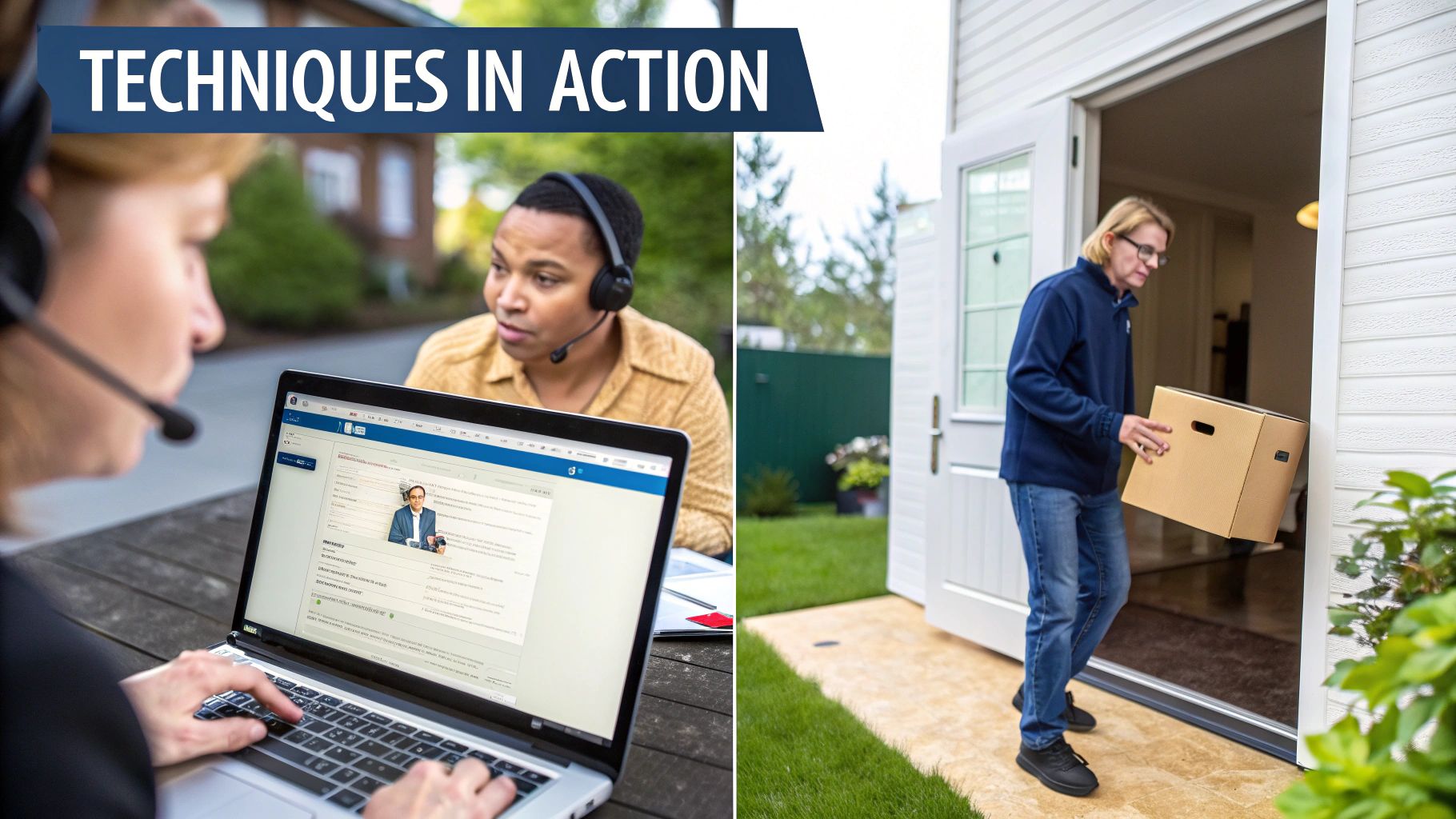
Getting Creative: Common Social Engineering Techniques in Action
To really get to grips with the human element in security, we need to move beyond theory and look at what attackers actually do. A social engineering pentest isn't a one-off trick; it's a carefully orchestrated campaign, using a whole arsenal of creative tactics to see how an organisation's defences hold up. These methods are designed to mirror the ingenuity of real-world threat actors, giving you a true measure of your team's readiness.
We can generally group these techniques by the channel they use: digital, voice, and physical. Each approach is chosen to exploit different facets of human psychology and organisational blind spots, from our built-in trust in technology to our natural desire to help someone who sounds like they're in charge.
Digital Deception: Spear Phishing and Whaling
For most social engineering tests, digital tactics are the go-to starting point. They're scalable, cost-effective, and can reach a lot of people quickly. But forget those generic, bulk phishing emails. A professional pentester goes for precision.
Spear phishing is all about crafting a highly personalised email aimed at a specific person or department. By using details uncovered during the reconnaissance phase—like a project name, a colleague’s job title, or a recent company event—the email looks completely legitimate and often urgent.
Example in Action: Imagine an accountant receiving an email that appears to be from their finance director. It mentions a real, upcoming payment to a supplier and urgently asks them to process a "revised" invoice attached as a PDF. Of course, that PDF is loaded with a payload designed to steal their credentials the moment it's opened.
Whaling takes this a step further, targeting senior executives or other high-value individuals (the "big fish"). The pretext here has to be flawless, as these targets are often more security-savvy. The goal is usually something big, like tricking them into authorising a fraudulent wire transfer or leaking strategic company secrets.
Voice Manipulation: Vishing and Smishing
Voice-based attacks, known as vishing, tap into the persuasive power of a human conversation. A friendly, confident, or even panicked voice can build rapport and create a sense of urgency that an email just can't match. A skilled vishing expert can think on their feet, adapting their story to bypass suspicion in real-time.
A well-executed vishing call bypasses technical controls entirely. It targets the user's instinct to trust and be helpful, turning a procedural security check into a conversation between two people.
Example in Action: A pentester, posing as an IT support agent from a known third-party supplier, calls an employee. They calmly explain that the employee’s account has been flagged for suspicious activity. To "prevent an immediate lockout," they just need the user to verify their identity by confirming their login details and the answer to a security question.
A close cousin to this is smishing (SMS phishing), which uses text messages to do the dirty work. These texts often contain links to fake login pages, playing on the fact that many people are less wary of links sent via text compared to email.
Physical Intrusion: Tailgating and Baiting
Physical social engineering tests are often the most eye-opening. They move beyond the screen to assess how an organisation’s real-world security—from reception policies to employee awareness—stands up to a challenge.
Tailgating is the classic act of following an authorised person through a secure entrance. A pentester might pull this off by carrying a stack of boxes, pretending to be deep in an important phone call, or simply looking like they belong there. This tests a fundamental human question: will an employee hold the door or challenge someone without a visible badge?
Example in Action: A consultant, dressed as a delivery driver, arrives at reception with a parcel addressed to a real employee. They act rushed and a little flustered, hoping to convince the receptionist to let them go straight to the person's desk instead of making them follow the proper sign-in procedure.
Baiting is another physical tactic that preys on human curiosity. It involves leaving a tempting object, like a company-branded USB stick, in a common area like a car park or kitchen. The device is loaded with software that, when plugged into a company computer, gives the pentester a foothold on the network.
These methods show precisely why this kind of hands-on testing is so important. UK businesses have faced an estimated 8.58 million cybercrimes in recent years, with social engineering being a top attack vector. Given that phishing is the entry point for the vast majority of network breaches, a proactive social engineering pentest has become a vital part of any serious defensive strategy. You can read more about the scale of cyber threats facing UK organisations on Security Boulevard.
Turning Your Pentest Findings into Actionable Reports
Let's be honest, the real work of a social engineering pentest begins after the test ends. The moment an employee clicks a link or gives up a password isn't the final result; it’s just a data point. The true value comes from turning those findings into a report that sparks genuine change within the organisation.
Think of the report as the bridge between a simulated breach and a real-world security uplift. It’s your chance to translate what happened into a story that leadership can’t ignore.
A good test churns out a lot of data. The trick is to sidestep the vanity metrics and focus on what actually signals business risk. You need numbers that tell a clear story about the company's human security posture, moving way beyond a simple pass or fail.
Key Metrics That Matter
When you're putting your findings together, the goal is to highlight behavioural patterns and procedural weaknesses. This helps stakeholders see exactly where the problems are, not just that they exist.
Here are the crucial metrics you should be tracking and highlighting:
Initial Engagement Rate: What percentage of people actually opened the email or answered the phone? This tells you how effective your initial pretext was.
Click-Through Rate (CTR): Of those who opened the email, how many took the bait and clicked the link or attachment? This is your core metric for digital susceptibility.
Credential Compromise Rate: This is a big one. What percentage of employees who clicked the link then went on to type their credentials into your fake login page? This quantifies a massive, high-impact risk.
Reporting Rate: How many people spotted the attempt and correctly reported it to IT or security? This is a fantastic positive metric. It shows you if the security awareness training is actually working.
Time to Detection: How long did it take for the blue team to spot the simulation and start reacting? This measures the maturity of their technical and procedural response.
Successful Physical Entries: For on-site tests, you need to document every single time you got in, whether by tailgating or talking your way past reception. It's also vital to note if employees challenged you or just held the door open.
Structuring a Report for Maximum Impact
A powerful report does more than just list what went wrong. It needs to guide the client towards a more secure future. The structure should tell a story, starting with the big picture and then drilling down into the nitty-gritty details.
The goal of a social engineering pentest report is not to assign blame but to provide a clear, evidence-backed roadmap for remediation. It should empower the client, not embarrass them.
Always lead with a tight, concise Executive Summary. This is for the C-suite, so keep it free of technical jargon. Clearly state the objectives, the overall risk level you discovered, and the most critical findings in plain business language. This is where you connect a phished password to potential financial loss or brand damage.
After the summary, you can get into the details of your methodology and results, leaning on those key metrics. Use charts and graphs to make the data easy to grasp at a glance. Remember, every finding needs to be backed by solid evidence—think anonymised screenshots, call logs, and access logs. You have to prove the vulnerability without naming and shaming individuals.
Finally, you get to the most important part: Actionable Remediation Steps. Don't just state the obvious, like "employees are susceptible to phishing." Give them specific, prioritised recommendations. For example, you might suggest targeted micro-training for the finance team because they had a low reporting rate, or recommend a complete overhaul of the visitor sign-in process.
Building reports with this level of detail is a core skill for any professional pentester. If you're looking to really dial in your process, it's worth exploring dedicated tools designed for this. You can learn more about optimising your entire workflow in our comprehensive guide to penetration testing reporting.
Frequently Asked Questions About Social Engineering Pentesting
When you’re dealing with social engineering tests, a lot of questions pop up. Clients want to know what they're getting into, and junior testers are keen to get the fundamentals right. Let's clear up some of the most common queries so you can walk into your next engagement with confidence.
Think of these answers as reinforcing the core pillars of any professional, ethical, and genuinely effective assessment.
How Often Should We Conduct a Social Engineering Pentest?
For most companies, running a test once a year is a good rule of thumb. But honestly, the 'right' frequency is all about your specific situation and risk appetite.
High-stakes industries like finance or healthcare, for example, should probably test more often. The same goes for any organisation that’s recently had a breach. In those cases, running tests bi-annually or even quarterly helps you see if your security awareness training is actually sticking. Big operational shifts, like a merger or a mass move to remote work, are also prime opportunities to see where the new cracks might be.
What Is the Difference Between a Pentest and a Phishing Simulation?
This is a really important distinction, and one that gets mixed up all the time. A phishing simulation is usually a broad-brush awareness exercise. You send a generic, often automated, email to a huge list of employees just to see who clicks. It’s a simple numbers game to get a baseline on susceptibility.
A social engineering pentest, on the other hand, is a different beast entirely. It's a highly targeted, objective-driven attack simulation run by a security pro. We're often using multiple angles—vishing, physical pretexting, you name it—to achieve a very specific goal, like getting into a server room or gaining admin credentials. It’s not just about awareness; it's a real test of your detection and response capabilities.
A phishing simulation asks, "Will someone click the link?" A social engineering pentest asks, "Can that one click lead to a complete company compromise?"
Can a Pentest Cause Real Business Disruption?
A professionally managed social engineering pentest is carefully designed to avoid any real-world damage or disruption. That’s non-negotiable. Before we even think about starting, we agree on strict rules of engagement in writing, which set clear boundaries that the testing team absolutely cannot cross.
The whole point is to prove a vulnerability exists without actually causing harm. For instance, I might take a screenshot showing I have access to a directory containing sensitive files, but I would never actually copy or exfiltrate that data. The goal is always to demonstrate the potential for impact, not to create actual impact. It's a safe, controlled, and constructive process.
Of course, turning those controlled findings into meaningful action is all down to effective reporting. To really nail how you present evidence and recommendations, take a look at our guide on building a master pentest report template for credible results. It shows you how to make sure every simulated test delivers genuine value.
Ready to stop wasting hours on manual report formatting? Vulnsy replaces tedious copy-pasting with powerful automation, helping you create professional, evidence-backed penetration testing reports in minutes, not hours. See how much time you can save and start your 14-day free trial at Vulnsy.com.
Written by
Luke Turvey
Security professional at Vulnsy, focused on helping penetration testers deliver better reports with less effort.